
Introduction: What This Is and Who It Is For
Many of the practitioners reading this guide already know the tension this tool was built to address. You work with people who are, by their own account, followers of Christ, and yet the frameworks you have been trained to use treat faith as background noise at best and a clinical complication at worst. The tools you reach for to understand wellbeing were not designed with your clients’ actual worldview in mind. And the tools that were designed for Christian contexts often lack the psychological rigor to be clinically useful, or they drift so quickly into devotional territory that the assessment work stops before it starts.
The Greatest Commandment Assessment™ (GCA) was built to close that gap. It is a 52-item psychological wellbeing instrument organized around the structure of Luke 10:27, the summary of the law that the lawyer recites to Jesus: “You shall love the Lord your God with all your heart and with all your soul and with all your strength and with all your mind, and your neighbor as yourself” (Luke 10:27, ESV). Those are not metaphors in this framework. They are the organizing architecture of a model that draws on both the Christian wellbeing literature and empirical positive psychology to describe what it actually looks and feels like, psychologically, to live that command faithfully. The assessment measures seven dimensions of wellbeing: Love the Lord, Heart, Soul, Mind, Strength, Love Yourself, and Love Others, producing a profile that reflects the whole person across the full range of what the Greatest Commandment asks.
This is not a diagnostic tool. It does not produce clinical findings, identify disorders, or replace any professional assessment you are already using. It is not a spiritual formation program, though it maps directly to one. And it is not self-help with a Bible verse attached. What it is, is a research-grounded instrument that gives you and your client a shared, theologically coherent language for talking about wellbeing, a structured way to see where a person is thriving, where they are stuck, and what the shape of their formation might need to look like next.
One distinction matters enough to name plainly at the start. The GCA is research-grounded, not formally validated. The model emerged from a directed qualitative content analysis of peer-reviewed Christian wellbeing literature, resulting in a theoretically robust construct structure. What it has not yet undergone is the full battery of psychometric validation procedures, including confirmatory factor analysis, test-retest reliability, and criterion validity. That work is underway, and every practitioner who introduces the GCA to clients and every client who completes it is contributing to the evidence base that will get it there. For now, use it as what it is: a research-grounded instrument for formative self-reflection, coaching conversations, and pastoral care contexts. Hold it with appropriate clinical humility, and it will serve your clients well.
This guide is written for three overlapping practitioner audiences: coaches, counselors and therapists, and formation-oriented pastoral leaders. Much of what is here applies across all three, and where the application differs meaningfully, those differences are named directly. What all three groups share is a concern for the people in their care, and a need for tools that take that care seriously, theologically and psychologically, without sacrificing one for the other.
The GCA was developed by Jennifer Collier, a board-certified health and wellness coach with nearly two decades of experience in Christian ministry and coaching, whose MSc research in applied positive psychology and coaching psychology at the University of East London is the foundation the instrument is built on. The tension this guide addresses is one she has navigated personally and professionally.
The Greatest Commandment Model™: A Framework Practitioners Can Work With
The Greatest Commandment Model™ (GCM) is a Christian psychological wellbeing model, which means it uses the methods of psychology to measure and describe what Scripture defines and authorizes. Those are not the same task, and the model does not confuse them. Psychology illuminates. Scripture anchors. Neither replaces the other, and the model is weaker if either is asked to do more than its proper work.
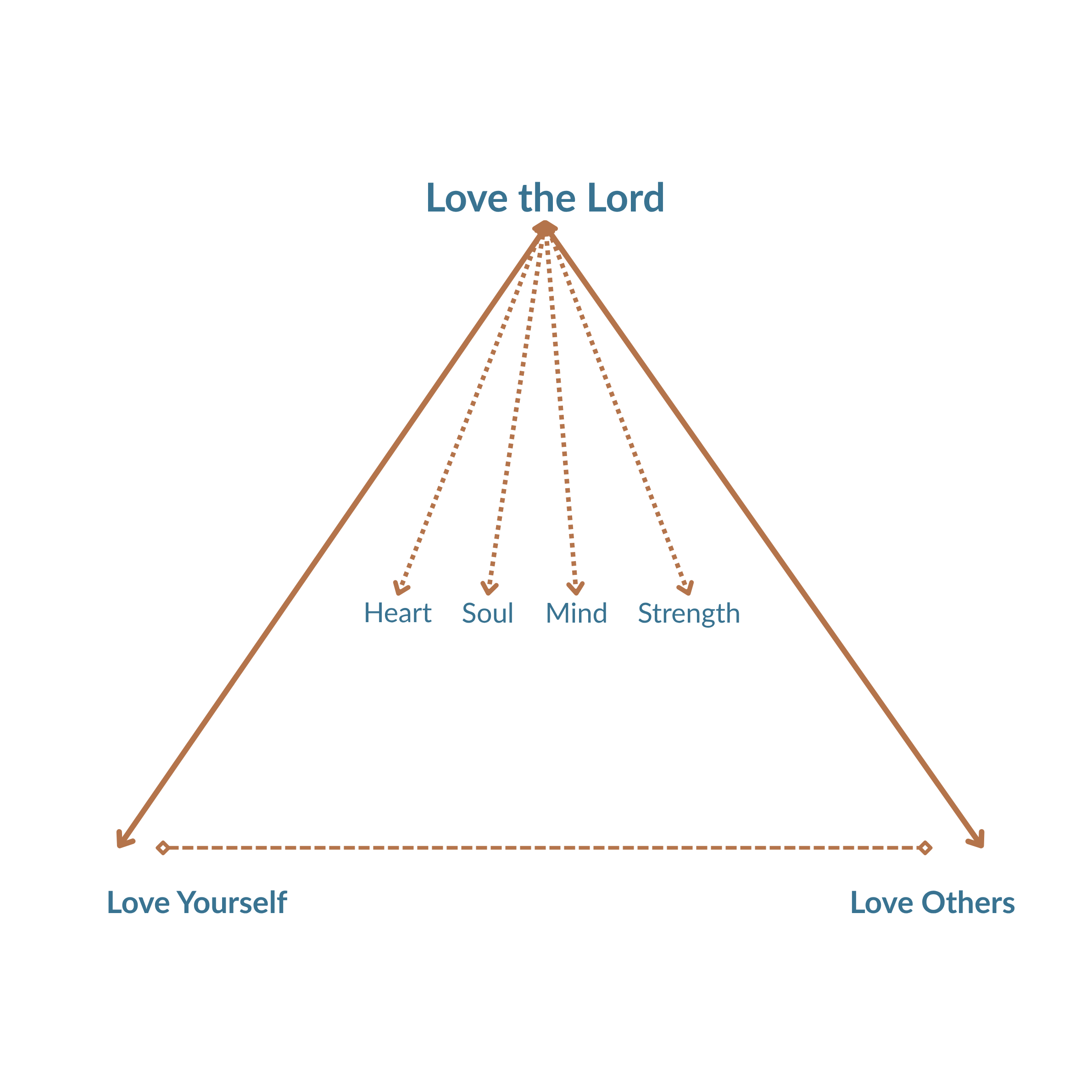
The model is organized around Luke 10:27, with its seven psychological dimensions identified from within the structure of that passage rather than mapped onto it from outside. That structure is not treated here as a devotional framework or a set of spiritual practices. It is treated as a structural description of the human person and of what flourishing looks like when a person is rightly ordered toward God, self, and others. The seven dimensions of the model map directly onto that structure.
Love the Lord is the primary and organizing dimension. It is not first in a list; it is the dimension from which every other dimension draws its meaning. Heart, Soul, Mind, and Strength are subdimensions of Love the Lord, which means they describe what it looks like, psychologically, to love God with the faculties the command names. Love Yourself and Love Others are peer dimensions, not subordinate to the subdimensions but in a different structural relationship to the whole. They describe how the orientation established in loving God extends outward toward the self and toward others. The eighth element of the model is the phrase Jesus appends in verse 28: “Do this, and you will live.” This is the telos of the whole, the outcome the model points toward rather than a dimension that can be measured.
Each dimension contains constitutive constructs, which are the psychological building blocks of wellbeing in that domain, and contextualizing constructs, which shape how wellbeing in that dimension is understood and expressed; both are addressed in detail in the following section.
One finding from the research that built this model deserves particular attention. When Christian wellbeing constructs were mapped against an existing positive psychology framework, roughly half aligned with established psychological lenses. The other half did not, and they did not align for a specific reason: they were not features of spiritual or religious experience that could be organized under existing categories. They were constructs predicated on a personal, relational covenant with God, irreducible to anything else. Communion with God, understood as ongoing relational engagement through prayer, scripture reading, and attentiveness to God’s presence. Intimacy with God, understood as emotional closeness, trust, and relational security with God. Vocational calling. Love for God’s creation. The manifestation of faith in observable practice. These constructs clustered together precisely because they shared a common characteristic: they could not occur outside of a living relationship with God. That structural distinctiveness required a new lens, named covenantal wellbeing, to hold them. This is not a theological claim inserted into a psychological model. It is what the literature itself produced. And it matters for practitioners because it means some of the most significant work with a client is not about strengthening a dimension but about whether the foundational relational reality that all the other dimensions depend on is actually present and alive.
The governing frame for everything the model describes is covenantal rather than therapeutic. Flourishing in the Greatest Commandment Model™ is not the goal of the Christian life, and it is not something a person manufactures through effort or achieves by working the right practices in the right order. It is the fruit of faithful alignment with God. The GCA serves that alignment by doing something specific and repeatable: it takes a snapshot of where a person stands across all seven dimensions at a given moment, giving both the practitioner and the client a clear picture of where they are oriented well and where they have drifted. That picture becomes the starting point for reorientation, the ongoing work of turning back toward what the command asks and living from that posture more fully.
“Do this, and you will live.”
Luke 10:28 (ESV)
The Seven Dimensions at a Glance
The following table provides a brief reference for each dimension. Fuller definitions are available in the practitioner resources in development.
Dimension
What It Measures
Love the Lord
The foundational covenantal relationship with God; the organizing dimension from which all others draw their meaning.
Heart
Soul
Emotional and affective life; the felt experience of living in relationship with God and others.
Mind
Strength
Love Yourself
Love Others
Love Others
Figure 1. The Greatest Commandment Model™ (Luke 10:27-28).
Internal orientation toward God; the domain of intention, desire, motive, and purpose.
Cognitive and interpretive faculties; how one reasons, evaluates, and understands through a faith-formed lens.
Active capacity and agency; the stewardship of energy, ability, and effort in service of love.
Reception and embodiment of God’s declared worth over one’s own life; honest self-regard grounded in imago Dei.
Active, Christlike extension of goodwill, compassion, and commitment toward others, grounded in their dignity as image-bearers.
The Assessment: What It Measures and How
The Greatest Commandment Assessment™ consists of 52 items organized across the seven dimensions of the Greatest Commandment Model™. Participants respond to each item on a seven-point scale ranging from strongly disagree to strongly agree. The instrument takes most people between ten and fifteen minutes to complete. It is free and entirely web-based. Participants receive their dimension scores immediately upon completion. The full narrative explanation of those scores is delivered by email. Creating a free account is an optional step that unlocks the ability to retake the assessment each quarter and track how the profile shifts over time, which is where the instrument becomes most useful as a formation and coaching tool.
Each of the seven dimensions produces a score that falls into one of three ranges: emerging, developing, or strong. These ranges are not grades. An emerging score in a dimension does not mean a person is failing in that area of their life, and a strong score does not mean they have arrived. The scores are descriptive, not evaluative. They describe where a person is currently experiencing wellbeing, where they are experiencing strain or depletion, and where there may be room for growth or reorientation. Read together, the seven scores produce a profile. That shape is unique to this person at this moment, and it is the shape of the profile rather than any single score that carries the most information.
To read a profile well, it helps to understand the difference between constitutive and contextualizing constructs. Constitutive constructs are what the dimension is actually made of, the psychological building blocks of wellbeing in that domain. In the Heart dimension, for example, constitutive constructs include emotional experience, emotional regulation, and the affective dimensions of a person’s relationship with God. These are the things that, when they are present and functioning well, produce what we recognize as wellbeing in that area. Contextualizing constructs are what shapes how wellbeing in that dimension is understood and expressed. They do not define the dimension, they situate it. A person’s sense of identity in Christ, for instance, contextualizes how they understand and inhabit nearly every other dimension of the model.
This distinction matters practically because an emerging score in a dimension does not tell you, by itself, what is driving it. Two people can score identically in the Strength dimension and be in entirely different situations: one is depleted because she has been giving from an empty well for years and needs rest and replenishment, another is struggling because he has never developed a theological framework for understanding his body and his capacity as a gift to be stewarded. The score opens the conversation. The constructs underneath it give it somewhere to go.
A practitioner who understands the construct structure of each dimension is better equipped to hear what a score is actually saying and to ask questions that open the right doors. Deeper construct-level resources, including full dimension definitions and construct-to-pathway mapping, are part of the practitioner tier currently in development. But even working from the profile alone, you and your client have a shared, structured starting point that most coaching or pastoral conversations do not have.
Administering the GCA
The Greatest Commandment Assessment™ is free and entirely web-based. Participants access it at assessment.luke1028.com/assessment and complete the 52 items at their own pace, receiving their dimension scores immediately upon completion. The full narrative explanation of those scores is delivered by email, so participants will need to provide an email address to receive it. Creating a free account is a separate and optional step, but one worth recommending to every client: it unlocks the ability to retake the assessment each quarter and track how their profile changes over time. A single snapshot is useful. A series of snapshots taken across a coaching engagement, a counseling relationship, or a significant season of formation work tells a much richer story, and it gives both you and your client tangible, visible evidence of growth and change. For practitioners, that longitudinal view can be one of the most concrete ways to track the efficacy of your work together.
How you introduce the assessment matters as much as the assessment itself. The framing you offer shapes what your client brings to it and what they are able to receive from the results. A few principles are worth holding as you do.
Introduce it as a reflection tool, not a test. The GCA has no right answers and no failing scores. It is a structured way of paying attention to where a person is right now across the whole of what it means to love God, love themselves, and love others. Framing it as an act of honest attention rather than an evaluation tends to reduce defensiveness and invite more genuine engagement with the items.
Situate it within the work you are already doing together. The GCA is most useful when it is not a standalone event but a moment within an ongoing relationship. Whether you are several sessions into a coaching engagement, working through a therapeutic relationship, or beginning a formation conversation with a congregant, the assessment gives that relationship a shared language and a structured starting point. Introduce it as a tool that will help you both understand where your client is and where the work might go next, not as a prerequisite to be completed before the real work begins.
A participant scores strong in Love the Lord, developing across Heart, Soul, and Mind, but emerging in both Strength and Love Yourself. This combination raises different questions than either emerging score would alone. A person who is strongly oriented toward God but emerging in both capacity and self-regard may be navigating any number of situations: a season of sustained demand that has outpaced replenishment, a theological framework that has not yet integrated care for the self as a spiritual responsibility, a life structure that leaves little room for either rest or reflection, or something else entirely. What the profile suggests is that the outward orientation is present but the inward resources may not be keeping pace. The practitioner’s work here is to explore what Strength and Love Yourself actually feel like from the inside for this person: what is available to them, what feels depleted or absent, and what their own sense is of how those dimensions relate to their faith. The formation conversation is not about whether the person is faithful enough. It is about what faithfulness looks like when it includes the self.
Pattern Two: Disruption at the foundation.
A participant scores emerging in Love the Lord, with developing or emerging scores scattered across the subdimensions and peer dimensions. The overall profile is flat and low. Before moving toward any formation pathway or intervention, this profile calls for unhurried curiosity about what is happening in the person’s relationship with God. An emerging Love the Lord score can mean many different things: a season of spiritual dryness, unprocessed pain or loss that has affected the relational foundation, a faith that is being reconstructed after a period of deconstruction, doubt that has not yet found a safe place to land, or simply a moment of honest self-assessment by someone who has never had language for what they are experiencing. The score does not tell you which of those things is true. What it does tell you is that the organizing dimension of the model is the place to begin the conversation, and that the questions worth asking are less about what to do next and more about what is actually happening in this person’s life with God right now.
Pattern Three: Uneven strength.
A participant scores strong across Love the Lord and its subdimensions, strong in Love Others, but emerging in Love Yourself. The profile shows an orientation that is moving both upward and outward but not reflexively. There are many possible reasons for that gap. The person may carry theological assumptions about self-care or self-regard that have not been examined. They may be in a relational or vocational context that consistently pulls their attention outward. They may have a well-developed capacity for love toward God and others that has simply not been extended toward themselves. They may also have a complicated relationship with the idea of loving themselves that has roots worth exploring. The practitioner’s work with this profile is to approach the Love Yourself score with genuine curiosity rather than a ready explanation, asking what that dimension feels like from the inside, what the person believes about whether they are included in the love they are extending to others, and what permission they have, or do not have, to turn that love toward themselves.
Pattern Four: Strong self, limited outward extension.
A participant scores strong in Love Yourself but developing or emerging in Love Others. This profile raises questions worth sitting with before drawing any conclusions, because the gap between a strong inward score and a lower outward one can have very different meanings depending on the person. It may reflect relational wounding that has made the movement toward others feel unsafe. It may point to a season of necessary internal focus that has not yet reopened outward. It may reflect a formation context that has emphasized inner healing without equally developing the call to neighbor love. It may also surface something worth exploring about how the person understands the relationship between loving themselves and loving others theologically. What it does not do, on its own, is tell you which of those things is true. The practitioner’s work with this profile is less about naming what is happening and more about asking questions that help the person locate themselves within it. What does loving others feel like from where they currently stand? Where does the movement toward others feel available, and where does it feel blocked or distant? What would it mean for the internal strength that is present to find its outward expression?
Opening the Conversation
How you open the results conversation shapes everything that follows.
Start with the participant’s own reaction, not yours. Before you offer any observation, ask what they noticed. What surprised them? What felt accurate? What felt incomplete or off? Their own reading of their results is data, and it often surfaces the most important things before you have said a word.
Name what you see in the profile before you name what it means. Consider the difference between describing the shape of a profile, for example “I notice your Love the Lord scores are strong and your Strength score is emerging,” and interpreting it, for example “It looks like you may be overextended.” The first invites the person into a shared observation. The second offers a conclusion they did not reach themselves, and conclusions arrived at from outside tend to close conversation rather than open it.
Hold the tension between what the scores show and what the person experiences. Scores are not the whole truth. A person may score developing in a dimension and feel that it is the area of their life where they are most alive. A person may score strong and feel deeply stuck. The results are a starting point for a conversation, not the conclusion of one.
For coaches: The GCA profile gives you a structured entry point that complements rather than replaces the coaching relationship’s fundamental orientation toward the client’s own agenda and insight. Use the profile to open doors, not to set the direction. A useful move is to ask the client to identify one score that feels most significant to them and begin there, rather than working through the dimensions systematically. Let the client’s own sense of where the energy is guide what gets explored first.
For counselors: In a therapeutic context, how a client responds to seeing their results may carry as much information as the results themselves. Approach the profile as one more piece of material the therapeutic relationship can work with, not as a findings report to be debriefed. Stay attentive to what the results surface emotionally and relationally, and be willing to set the profile aside entirely if what it opens is more important than what it shows.
For pastoral leaders: The profile gives you a theologically grounded language for a conversation that pastoral care often struggles to structure. You do not need clinical training to read a profile well. You need curiosity, patience, and the theological conviction that where a person is right now is not where the story ends. The model’s covenantal framing means that even an emerging score is not a verdict. It is an invitation.
During the Results Conversation
□ Open by asking what the client noticed, not by sharing your observations.
□ Read the Love the Lord score first as the organizing dimension.
□ Name what you see in the profile before naming what it means.
□ Look for coherences and tensions across the whole profile before focusing on any one dimension.
□ Let the client identify which score feels most significant before you suggest one.
□ Hold the tension between what the scores show and what the client experiences.
□ End the conversation with a clear next step, question, or invitation to carry forward.
Mapping Results to Formation Pathways
The Greatest Commandment Assessment™ is designed to do more than describe where a person is. It is designed to point somewhere. The Luke 10:28 Project formation pathways are where that pointing leads, and understanding how results map to pathways is one of the most practically useful things a practitioner can take from this guide.
Each formation pathway corresponds to a domain of the Greatest Commandment Model™. The core domain pathways currently available are Love the Lord, Love Yourself, and Love Others, alongside the subdomain pathways With All Your Heart, With All Your Soul, With All Your Mind, and With All Your Strength. Additional focused protocols in development will go deeper into specific constructs within each domain. Each pathway is a twenty-eight-day, self-guided digital workbook that a participant moves through on their own, though the practitioner relationship surrounding it shapes how much they are able to receive from it.
Every pathway follows the same four-week structure. The first week, Orient, is about observation. Before anything is taught or practiced, the participant is invited to pay attention and notice what is actually present in this dimension of their life without immediately trying to change it. The second week, Understand, provides psychoeducation grounded in both psychological research and theological reflection, giving the participant language and framework for what they have been observing. The third week, Practice, moves into participant-selected interventions. Rather than prescribing a single approach, the pathway offers a range of practices and invites the participant to choose what fits their life, their temperament, and where they are. The fourth week, Anchor, integrates what has been observed, learned, and practiced into something the participant can carry forward. The four weeks are designed to build on each other, and the structure is deliberate: observation before understanding, understanding before practice, practice before integration.
Formation Pathway Structure
Week 1
ORIENT
Observation
Week 2
UNDERSTAND
Psychoeducation
Week 3
PRACTICE
Activities & Interventions
Week 4
ANCHOR
Integration
Figure 3. The Luke 10:28 Project four-week formation pathway structure.
Connecting Results to Pathways
The most direct mapping is also the most obvious one: a dimension where a participant scores emerging is a natural starting point for a formation pathway in that domain. But the most obvious mapping is not always the most useful one, and part of the practitioner’s work is to think carefully about where to begin.
A participant with an emerging Love the Lord score and developing scores across the subdimensions may need to begin with the Love the Lord pathway, but they may also need something more foundational first: a conversation, a referral, or simply more time before a self-guided workbook is the right next step. Pattern Two from the previous section is the profile where this question is most acute.
A participant with a strong Love the Lord score but emerging scores in Love Yourself and Strength may benefit most from beginning with whichever of those two dimensions feels most alive to them, rather than whichever scores lowest. The Orient week of the pathway is designed to meet the participant where they are, but they have to be willing to look. Starting with the dimension the participant is most curious about, rather than the one that looks most depleted on paper, tends to produce more genuine engagement with the material.
When a participant has multiple emerging scores, resist the temptation to recommend multiple pathways at once. Twenty-eight days of focused attention in one domain is more likely to produce lasting reorientation than twenty-eight days of divided attention across several. The breadth of the model is for assessment. The depth of the pathway is for formation, and formation requires focus.
For coaches: The GCA fits naturally into a discovery session or early engagement conversation. Sending it before your first or second session gives you a shared framework from the start and helps the client articulate dimensions of their life they may not yet have language for.
For counselors: Introduce the GCA as a formation and wellbeing tool that complements the therapeutic relationship, not as a clinical instrument. Be clear with clients that it is distinct from any formal psychological assessment you may be using, and that its purpose is to support self-awareness and directional growth, not diagnosis or treatment planning.
For pastoral leaders: The GCA works well within individual pastoral care conversations and as an entry point for spiritual direction. When introducing it to a congregant, emphasize that the results are personal and that the conversation you have together around them is a safe and private space. For practitioners considering group or congregational use of the GCA, guidance on that context is addressed in Section 7.
Be honest about what it is. You do not need to over-explain the research grounding, but you should be clear that this is a research-grounded instrument developed within Christian psychology, not a validated clinical measure. Most clients will not ask, and most will not need that distinction, but if a client is clinically sophisticated or has experience with formal psychological assessment, naming it accurately builds trust rather than undermining it.
Give clients time with their results before you discuss them together. When possible, send the assessment link before a session and ask the client to review their profile on their own first. Ask them to notice what surprises them, what resonates, and what feels incomplete or off. Their initial, unmediated reaction to their own results is often more revealing than anything that emerges in a directed conversation, and it gives them a sense of ownership over the profile before you begin interpreting it together.
Before the Results Conversation
□ Send the assessment link at least twenty-four hours before the session.
□ Ask the client to review their results beforehand and note what surprised them, what resonated, and what felt incomplete or off.
□ Review the results yourself before the session.
□ Read the overall profile shape before examining individual scores.
□ Identify any coherences or tensions across the profile worth exploring.
□ Prepare two or three open questions based on what you observe.
□ Consider whether the profile raises any referral questions before the session begins.
Interpreting Results with a Client
Results in hand is not the moment to start talking. It is the moment to start looking.
Before you examine any individual dimension score, read the profile as a whole. What is the overall shape? Is this a person whose scores are relatively consistent across dimensions, or is there significant variation? Are there clusters of emerging or strong scores that sit next to each other in the model’s structure? The shape of a profile carries information that individual scores do not, and moving too quickly to examine dimensions in isolation is one of the most common ways a results conversation loses its footing.
The model has a structural logic that shapes how you read that whole. Love the Lord is the organizing dimension, and Heart, Soul, Mind, and Strength are its subdimensions, describing what it looks like psychologically to love God with the faculties the commandment names. Love Yourself and Love Others are peer dimensions, extending the orientation established in that primary relationship outward toward the self and toward others. That hierarchy is not incidental. It means that when the Love the Lord dimension is emerging, you are looking at something different than when a subdimension is emerging in isolation. A person whose Love the Lord score is emerging is not simply low in one area of their life. Something may be happening at the relational foundation from which everything else draws meaning, and that warrants a different quality of attention than, say, a Strength score that is emerging while everything else is developing or strong. Reading the profile with that structural logic in mind keeps you from treating all dimensions as equivalent when the model itself does not.
Look for coherences and tensions before you look for problems. A coherence is a pattern where scores across related dimensions tell a consistent story. A tension is where they do not, and tensions are often where the most important formation work lives. Neither coherences nor tensions are problems to be solved. They are the shape of this particular person’s life at this particular moment, and your work is to help them see that shape clearly before either of you moves toward what to do about it.
Love the Lord
Heart
Soul
Mind
Strength
Love Yourself
Strong
Developing
Developing
Developing
Emerging
Emerging
Developing
Emerging
Developing
Emerging
Strong
Figure 2. Illustrative profile snapshot – Pattern One: Strong Foundation, Depleted Self. Composite example only; not drawn from a real participant. Visual profile reporting is a planned product feature.
Reading the Profile: Four Illustrative Patterns
The following profiles are illustrative composites, not drawn from real participants, and intended to demonstrate how a practitioner might begin to read and respond to a profile. They are starting points for curiosity, not diagnostic categories.
Pattern One: Strong foundation, depleted self.
Connecting Results to Pathways
How you recommend a pathway matters as much as which pathway you recommend. The goal is an invitation, not an assignment.
An assignment positions the practitioner as the authority who has identified the problem and prescribed the solution. An invitation positions the participant as someone who has seen something true about themselves and is being offered a structured way to explore it further. The difference is not just rhetorical. It shapes whether the participant approaches the pathway with genuine curiosity or with the compliance and mild resistance that tends to accompany things we feel we should do.
A useful frame is to share what you noticed in the profile, ask the participant what resonates, and then describe the pathway as something that exists for exactly that kind of exploration. Not “I think you should work through the Love Yourself pathway” but “Given what you said about how that dimension feels, the Love Yourself pathway might be worth looking at. It’s twenty-eight days, self-paced, and it starts with observation rather than prescription. Would that feel useful?”
The pathways are participant-purchased. Your role as a practitioner is to recommend and support, not to administer. Participants access and purchase pathways directly through the Luke 10:28 Project at luke1028.com/formation-pathways. A practitioner tier that allows for more formal integration of pathways into a coaching or counseling practice is currently in development. If that kind of structural access is something you are interested in, information on how to stay connected as that tier develops is in the closing section of this guide.
Scope of Practice and Appropriate Use
The Greatest Commandment Assessment™ is a research-grounded wellbeing instrument. It is not a clinical diagnostic tool, and it is not a substitute for professional mental health care, medical care, or formal psychological assessment. Holding those boundaries clearly is not a limitation on the instrument’s usefulness. It is what makes the instrument trustworthy, and it is what protects both the people you serve and the integrity of your practice.
What the GCA Is Appropriate For
The GCA is well suited for use in coaching relationships, pastoral care conversations, spiritual direction, and formation-oriented contexts where the goal is self-awareness, growth, and reorientation toward faithful living. It is appropriate for use with adults who are functioning well enough to engage in honest self-reflection and who are not in acute crisis. It is a useful tool for opening conversations about wellbeing, identifying areas of growth and formation, and connecting participants to structured pathways for development. It is also appropriate as a longitudinal tracking tool, used periodically over time to observe how a person’s wellbeing profile shifts across seasons of life and formation work.
What the GCA Is Not Appropriate For
The GCA is not appropriate as a substitute for clinical assessment in contexts where a participant may be experiencing significant mental health concerns, trauma, crisis, or symptoms that warrant professional evaluation. It is not appropriate to use as a diagnostic instrument, to make clinical determinations, or to include in clinical documentation as a validated measure. It is not appropriate for use with minors without specific guidance that falls outside the scope of this guide. And it is not appropriate to administer in contexts where the results could be used to evaluate, judge, or categorize a person rather than to support their growth.
Knowing When to Refer
One of the most important things a practitioner can do with a GCA profile is recognize when the conversation it opens points beyond what the instrument, the pathway, or the practitioner relationship can appropriately address.
A participant whose profile and subsequent conversation suggests significant depression, anxiety, trauma, grief, or other clinical concerns warrants a referral to a licensed mental health professional, regardless of how the GCA scores present. A participant whose emerging Love the Lord score opens a conversation about spiritual crisis, abuse within a religious context, or profound theological disorientation may need more than a formation pathway and a supportive practitioner relationship. A participant who presents with physical health concerns that are affecting their Strength scores may need medical attention before formation work is the right next step.
Referral is not a failure of the practitioner relationship. It is an act of care. The GCA can remain a useful part of the picture even when other professional support is also present, but it should never be used to delay or replace care that a participant genuinely needs.
Consider Referral When a Participant's Profile or Conversation Surfaces Any of the Following
□ Signs or symptoms suggesting significant depression, anxiety, trauma, or other mental health concerns.
□ Active crisis, grief, or loss that exceeds the scope of formation and coaching work.
□ Spiritual crisis, profound theological disorientation, or experience of religious abuse or harm.
□ Physical health concerns that are materially affecting capacity and the Strength dimension.
□ Safety concerns of any kind.
□ Persistent patterns suggesting the need for therapeutic intervention rather than formation support.
A Note on Scope Across Practitioner Roles
Coaches, counselors, and pastoral leaders each hold different scope of practice boundaries, and the GCA should be used in a way that is consistent with those boundaries.
For coaches: The GCA sits comfortably within a coaching scope of practice as a reflective and formative tool. Coaches should be attentive to when a results conversation surfaces material that moves beyond coaching into therapeutic territory, and should have a clear referral pathway in place before that situation arises rather than after.
For counselors: Licensed mental health practitioners have the broadest scope for working with what the GCA surfaces, but should be careful not to allow the instrument to function as a clinical measure it was not designed to be. Use it as a relational and formative tool within the therapeutic relationship, not as a supplement to formal clinical assessment.
For pastoral leaders: Pastoral care relationships carry significant trust and influence, and that trust creates responsibility. Be attentive to the limits of what a pastoral relationship can appropriately hold, and be willing to refer to both mental health professionals and medical providers when what a conversation surfaces exceeds those limits. The GCA is a tool for formation, not a framework for crisis response.
Group and Congregational Use
The GCA can be a meaningful tool in group and congregational contexts, but group use raises considerations that individual use does not. Participants in a group setting should always have full control over whether and how they share their results. Results should never be disclosed, compared, or discussed in a group format without explicit and informed consent from the participant. Formation groups built around a shared pathway can be a powerful context for growth, but the safety of that context depends on clear agreements about confidentiality and the voluntary nature of sharing.
Practitioners considering group use are encouraged to think carefully about the relational culture of the group before introducing the assessment, and to establish clear norms around privacy and participation before any results are discussed.
Dedicated guidance for group and congregational use, along with deeper practitioner resources for working with the GCA in clinical and coaching contexts, is in development. Information on how to stay connected as those resources become available is in the closing section of this guide.
Common Questions
On research grounding and validation
Practitioners with a clinical background will often ask whether the GCA has been formally validated, and the honest answer is that it has not, not yet. The instrument is research-grounded, built on a directed qualitative content analysis of peer-reviewed Christian wellbeing literature that produced the construct structure the assessment is built on. That foundation is theoretically robust and methodologically rigorous. What it has not yet undergone is the full battery of psychometric validation procedures, including confirmatory factor analysis, test-retest reliability, and criterion validity studies. That work is underway, and every practitioner who introduces the GCA to clients is contributing to the evidence base that will get it there.
What this means practically is that the GCA should be held as what it is: a research-grounded formation and wellbeing tool, not a validated clinical measure. It is appropriate to use it with confidence in coaching, pastoral care, and formation contexts while being honest with clinically sophisticated clients about where the validation process currently stands. That honesty is not a weakness. It is what makes the instrument trustworthy.
On theological positioning
The GCA is a psychological model informed by theology, not a theological framework. That distinction matters for how practitioners use it. The instrument does not tell a participant what they should believe, how they should pray, or what their spiritual life should look like. It describes what wellbeing looks like, psychologically, when a person is living faithfully within the framework of the Greatest Commandment. The psychological constructs it measures are descriptive of what faithful living produces, not prescriptive techniques for producing it.
Practitioners sometimes ask whether the instrument is compatible with their particular theological tradition. The GCA is grounded in the core doctrines that orthodox Christianity holds across its major traditions: Trinitarianism, Christian anthropology, and the dignity of persons as bearers of the image of God. The research that built the model drew on literature from multiple orthodox Christian traditions, and the construct structure that emerged reflects theological commitments shared broadly across those traditions rather than the distinctives of any one. Practitioners from mainline Protestant, evangelical, and broader orthodox Christian backgrounds should find the instrument theologically coherent. The GCA does not adjudicate theological differences between traditions and does not make claims that belong to systematic theology. It measures what wellbeing looks like when a person is living within the relational framework the Greatest Commandment describes, and that framework is one the broad orthodox Christian tradition recognizes.
On use with non-Christian clients
The GCA is designed for use with professing Christians, and that boundary is intentional rather than incidental. The instrument is built on the assumption of a personal relationship with Jesus. Its constructs, its framing, and the formation pathways it points toward all presuppose that relational foundation. Using it with participants who do not share that foundation would not produce meaningful results, because the thing the instrument is measuring would not be present in the same way.
This does not mean the GCA has no place in conversations with seekers or people exploring faith. A practitioner might find it useful as a way of describing what Christian wellbeing looks like and inviting a person to consider where they stand in relation to it. But that is a different use than administering it as a wellbeing assessment, and practitioners should hold that distinction carefully.
On how the GCA relates to other tools
Practitioners often come to the GCA already using other instruments, and a reasonable question is how it fits alongside them. The short answer is that it is not designed to replace any tool a practitioner is already using well. It is designed to do something those tools do not.
Personality and behavioral instruments like DISC describe how a person tends to engage with the world. The Enneagram describes patterns of motivation and habit of being. Emotional health assessments like the Emotionally Healthy Discipleship assessment measure the integration of emotional and spiritual maturity. These are all useful lenses, and the GCA does not compete with them. What it adds is a theologically grounded, dimensionally structured picture of where a person is experiencing wellbeing across the whole of what the Greatest Commandment asks of them. It is less concerned with how a person is wired and more concerned with how they are currently oriented, and that orientation is something that can shift and be formed over time.
Practitioners who already use the Enneagram or similar tools will find that the GCA complements them naturally. The GCA provides the wellbeing profile. Other instruments provide the dispositional and developmental context. Used together, they give a richer picture than any one of them provides alone.
Closing and Next Steps
The Greatest Commandment Assessment™ exists because the people sitting across from you in coaching sessions, counseling offices, and pastoral conversations deserve a framework that takes their whole life seriously, including the part that is oriented toward God. Not as a demographic variable. Not as a complicating factor. As the organizing reality of who they are and how they flourish.
The GCA gives you a structured, research-grounded way to see that whole life clearly, to have conversations that might otherwise take months to find their footing, and to point people toward formation work that is theologically serious and psychologically informed. That is what it was built to do, and that is what it is for.
How to Access the Assessment
The Greatest Commandment Assessment™ will be available free of charge in summer of 2026. Participants complete the 52 items online, receive their dimension scores immediately, and receive the full narrative explanation of their results by email. Creating a free account allows participants to retake the assessment each quarter and track how their profile shifts over time.
How to Find the Formation Pathways
The Luke 10:28 Project formation pathways are available at luke1028.com/formation-pathways. The core domain pathways currently available are the Love the Lord, Love Yourself, and Love Others pathways, alongside the subdomain pathways With All Your Heart, With All Your Soul, With All Your Mind, and With All Your Strength. Each pathway is a twenty-eight-day self-guided digital workbook following the four-week Orient, Understand, Practice, and Anchor structure. Additional focused protocols going deeper into specific constructs within each domain are in development and will be added to the project as they become available.
Staying Connected
A practitioner tier is in development that will provide deeper construct-level resources, group and congregational use guidance, and more formal tools for integrating the GCA and the formation pathways into a coaching or counseling practice. If that is something you are interested in, the best way to stay connected as it develops is www.luke1028.com/center-home. Dedicated guidance for group and congregational use is also forthcoming as part of that development.
A Word from Jen
I did not build the Greatest Commandment Model™ or the Greatest Commandment Assessment™ because I had the answers. I built them because I kept encountering the same question, in my own life, in my coaching practice, in my research: how do we actually do this? How do we live the Greatest Commandment not as an aspiration but as a practiced, embodied reality? How do we help the people in our care do the same?
The research that produced this model surprised me in the best possible way. What emerged from a careful examination of the Christian wellbeing literature was not a new framework imposed on Scripture but a confirmation of what Scripture had already named. The structure was there all along. The psychology simply helped us see it more clearly.
What I hope this guide gives you is not just a new tool but a new kind of conversation. One that begins with honest attention to where a person actually is, holds that reality with theological seriousness and psychological care, and points toward the ongoing work of reorientation that is, I believe, what formation has always been about.
The people you serve are worth that kind of attention. So is the work you are doing to give it to them.
Want a PDF copy to keep on hand?
Get the guide PDF and occasional updates as the practitioner tier develops. Unsubscribe anytime.