
THE MODEL
The Greatest Commandment Model™
A research-based framework for Christian well-being, built on the relational structure of Luke 10:27-28. It gives Christians, practitioners, and churches a shared language for understanding where someone is thriving and where they are not, and a practical path for growing closer to God, themselves, and others.
"You shall love the Lord your God with all your heart and with all your soul and with all your mind and with all your strength. You shall love your neighbor as yourself."
LUKE 10:27-28, ESVWHERE IT COMES FROM
The Greatest Commandment is not a new idea. It is the summary the lawyer offered of the entire law, affirmed by Jesus, rooted in the Shema of Deuteronomy and carried through centuries of Christian thought. Augustine organized his theology of love around it. Contemporary Christian Psychology literature returns to it again and again as the most concise articulation of what a rightly ordered human life looks like.
What has been missing is a framework that takes that structure seriously at a psychological level, that maps what we know from well-being research onto what the commandment actually describes, and that gives people something they can use. The Greatest Commandment Model™ is built to do that.
HOW IT IS STRUCTURED
The model is organized around seven domains drawn directly from Luke 10:27-28.
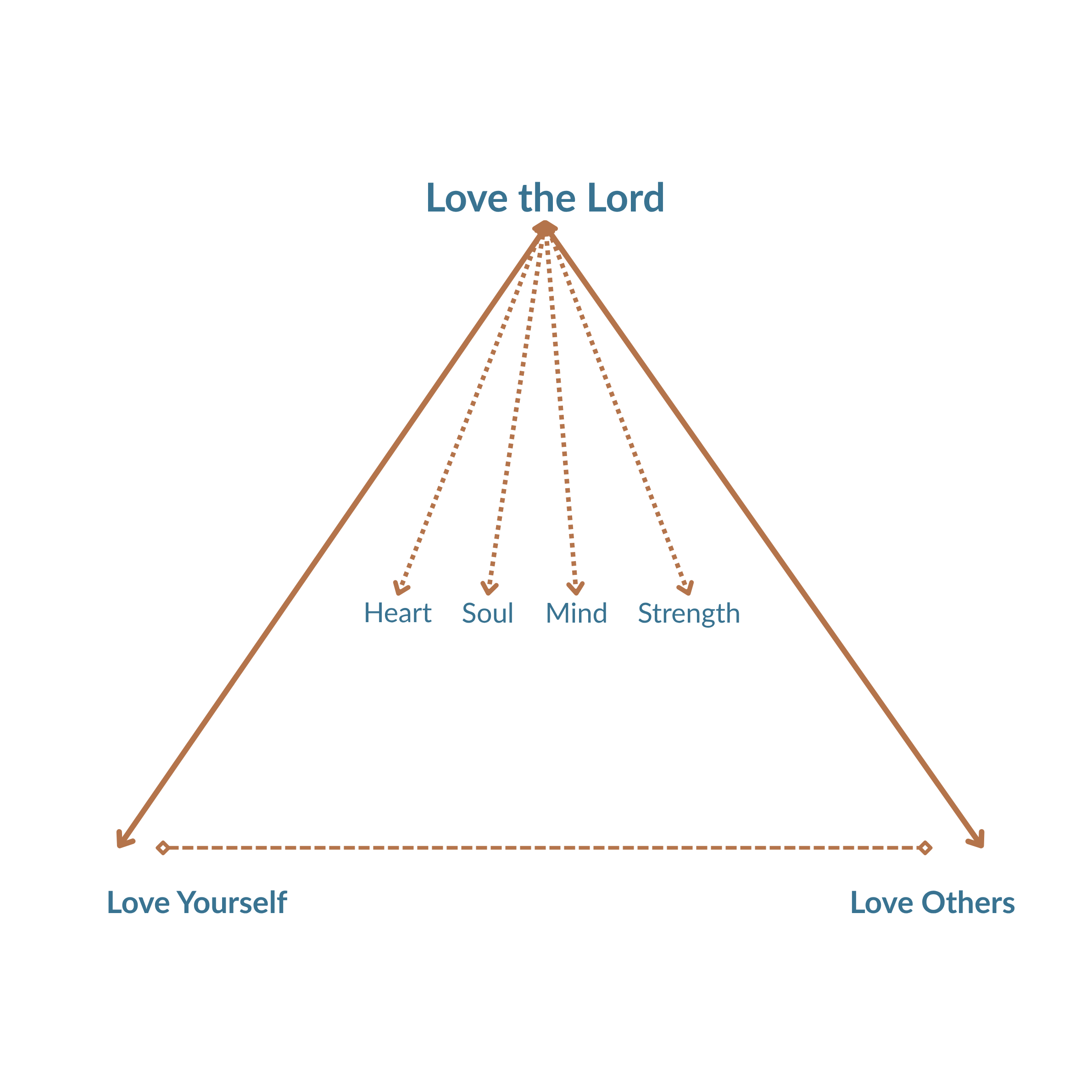
Three are relational and hierarchically ordered. Four describe the dimensions of how we love God with the whole person.
THE THREE RELATIONAL DIMENSIONS
Love the Lord is the primary and organizing dimension of the model. It is not reducible to religious practice or doctrinal knowledge but describes the full quality of a person's covenantal relationship with God, the source from which everything else flows. It encompasses the whole person across four dimensions: Heart, Soul, Mind, and Strength.
Love Yourself and Love Others emerge from that primary relationship as overflow, parallel to one another and grounded in the same foundation: every person, including yourself, bears the image of God and has been declared worthy of love by the One who made them. These two dimensions are not subordinate in value, but they are dependent in order.
THE FOUR DIMENSIONS OF LOVING GOD
Heart
The internal orientation of the whole person toward God, encompassing thoughts, desires, motives, and purposes.
Mind
The cognitive and interpretive faculty, encompassing understanding, reasoning, and evaluative judgment submitted to God.
Soul
The affective and felt inner life, encompassing the full range of emotional experience offered to God in wholehearted trust.
Strength
The active, embodied capacity of the person, encompassing every ability, effort, and resource directed toward God's purposes.
THE SEVEN DIMENSIONS
Each dimension describes a distinct facet of what it means to love God, yourself, and others with the whole person.

-
Love the Lord is the organizing center of the model. It describes not a category of religious behavior but the living relational dynamic between the person and the God who initiates, sustains, and defines the relationship. It is the covenantal foundation from which all other dimensions flow.
This dimension encompasses the full quality of a person's relationship with God as it is actually lived and felt: the sense of attachment and secure bond, intimacy and depth of closeness, communion and felt mutual presence, grace and unmerited acceptance, forgiveness and restored relational standing, peace as inner wholeness, and thankfulness as a stable orientation toward God's goodness. These are not abstract theological categories but experiential realities that can be assessed and grown.
Love the Lord is shaped by faith as enduring trust in God's character, reliance on His sovereignty, willingness to yield one's will to His, and the behavioral expression of covenantal loyalty. Within the model, it is not one dimension among equals but the generative source from which Love Yourself and Love Others emerge.
Key Constructs
Attachment to God · Intimacy with God · Communion with God · Grace from God · Forgiveness from God · Peace / Shalom · Thankfulness to God
-
In biblical usage, the heart is not merely the location of emotion. It is the governing center of the self, the place where treasure is held, where loyalty is formed, and where the fundamental direction of a person's life is set. To love God with all the heart is to align the entire motivational world of the person toward Him as its supreme object and source of meaning.
Psychologically, Heart is the dimension most closely associated with purpose, meaning, and the motivational orientation of the inner life. It encompasses a person's sense that their life is directed toward meaningful, God-discerned ends; a hope grounded in God's character that shapes present engagement; and a thankfulness that functions as a stable affective orientation toward His goodness rather than a performed expression of gratitude.
Heart is formed over time through character and virtue development, sustained by faith and genuine devotion, and oriented toward an eschatological horizon that prevents the inner life from collapsing into short-term or self-directed ends.
Key Constructs
Purpose in life · Hope · Thankfulness · Character and virtue formation · Eschatological hope · Fruit of the Spirit
-
The soul is the felt inner life of the person, the seat of feelings, desires, and longings through which the meaning of life is interpreted and experienced. To love God with all the soul is not to achieve emotional positivity or suppress the difficult range of human feeling, but to offer the entire felt inner world to God with honesty and trust.
Psychologically, Soul is the dimension most closely associated with the affective quality of life in relationship with God. It encompasses joy as a depth of gladness rooted in God's character rather than favorable circumstance; peace as the inner stability that attends life held within His goodness; contentment as a settled confidence in His provision; awe as the encounter with divine transcendence that reorients the emotional life; and hope as an affectively felt anticipation that sustains the inner life through uncertainty.
Soul also encompasses the movement of difficult emotions, including anxiety, grief, shame, and anger, toward truth and goodness within the covenantal relationship. Not through suppression, but through the honest bringing of the full emotional world before God.
Key Constructs
Joy · Peace · Contentment · Awe · Hope · Emotional intelligence · Emotional regulation
-
To love God with all the mind is not merely to think about God but to submit one's entire interpretive framework to Him, so that reasoning, perception, and meaning-making are progressively aligned with His truth. The mind is the faculty through which understanding is formed, meaning is made, and life experience is evaluated and integrated.
Psychologically, Mind is the dimension most closely associated with meaning-making and cognitive appraisal. It encompasses a person's reflective evaluation of their life and sense of satisfaction within it; the experienced sense of continuous growth and deepening self-knowledge; intersubjectivity as shared meaning-making with God enabled by the Holy Spirit; and Christian mindfulness as present-moment attentiveness paired with prayerful openness to God's presence.
Mind is shaped by the ongoing renewal of thought toward God's will, by honest self-awareness and self-examination, and by the integration of sacred meaning into the full range of life experience, including suffering, doubt, and unresolved questions.
Key Constructs
Life satisfaction · Personal growth · Intersubjectivity · Christian mindfulness · Spiritual cognition · Spiritual authenticity · Sanctification
-
Strength is not reducible to physical vigor or productivity, and it is not limited to vocation. It encompasses the total extent of a person's active capacity, every resource, effort, ability, and means, offered to God across the full range of daily life. Whether eating or working, resting or serving, the question Strength asks is whether the whole of one's active life is being lived to the glory of God.
Psychologically, Strength is the dimension most closely associated with agency, active engagement, and the embodied expression of faith in everyday life. Its core experiential construct is vocational engagement, understood broadly as meaningful and appropriately challenging participation in whatever God has called and positioned a person to do, whether in formal work, service, relationships, or the ordinary rhythms of daily life. This is not performance-driven productivity but covenantal participation, the experience of living actively and fully in response to God rather than for one's own ends.
Strength is sustained by a sense of divine purpose underlying one's efforts, by perseverance and resilience through difficulty, by the capacity to regulate one's impulses and align behavior with one's values, and by the hopeful agency of one who trusts that God's purposes can be pursued in every arena of life, not just the sacred ones.
Key Constructs
Vocational engagement · Vocational calling · Fulfilling God's purpose · Grit · Resilience · Self-control · Faith maturity
-
The inclusion of self-love in a Christian model requires theological grounding before it can be psychologically useful. The warrant is not found in the self itself but in the God who made and redeems it. Every person is made in the image of God, and that declared worth is not diminished by failure, suffering, or sin. To refuse honest self-regard is, within this framework, to resist the love of the One whose image you bear.
Love Yourself describes the reflexive dimension of Christian well-being, in which the love received from God is turned inward with honesty and care. It is constituted by self-integrity as experienced coherence and honest integration of one's inner life; religious self-esteem as a sense of personal worth grounded specifically in one's identity as loved and redeemed by God; and self-compassion as the capacity to extend toward oneself the same grace that God extends, particularly in moments of failure or limitation.
This dimension is grounded in identity in Christ as the primary theological anchor, and shaped by the care of one's physical life as faithful stewardship and the integration of one's sense of calling into a coherent sense of self.
Key Constructs
Self-integrity · Religious self-esteem · Self-compassion · Identity in Christ · Stewardship of the body · Positive vocational identity
-
The warrant for loving others is not found in their lovability, nor in social contract or emotional resonance, but in the same theological foundation that grounds Love Yourself. Every other person, without exception, bears the image of God. That shared image-bearing is what makes love for others not merely an ethical preference but a theological obligation, a response to the same God whose image one also bears.
Love Others describes the horizontal dimension of Christian well-being, in which love received from God overflows outward toward every person without boundary or exclusion. It is constituted by the experienced sense of belonging and meaningful participation within the body of believers; the quality of connection within one's work or service contexts; the felt sense that one's presence meaningfully benefits others; and the experience of being genuinely embedded in and cared for within the broader community.
This dimension is shaped by agapic love as unconditional, God-sourced commitment to the wellbeing of others; expansive love as the extension of that commitment beyond the natural boundaries of preference or proximity; and stewardship of creation as the broader posture of faithful care for all that bears God's mark.
Key Constructs
Attachment to church community · Positive vocational relationships · Social contribution · Social integration · Perceived social support · Agapic love · Expansive love
THE TELOS
Live
Live is not a dimension to be measured alongside the others. It is the telos the model points toward, the promised outcome of Luke 10:28: "Do this and you will live." It describes the abundant life of John 10:10, not as the absence of suffering or difficulty, but as a holistic quality of being in which all dimensions of the person are held within the purposes and presence of God.
It is simultaneously a present reality and a future hope, held together not by the resolution of suffering but by the spiritual richness born of deep faith, enduring love, and audacious hope even in the midst of hardship.
WHAT IT IS AND WHAT IT IS NOT
The Greatest Commandment Model™ is a psychological framework informed by theology. It is not systematic theology, and it is not a replacement for scripture, pastoral care, or the life of the church. It is a tool for understanding where a person is in their journey and what might help them grow.
It is descriptive before it is prescriptive. It names what Christian well-being looks like across the full range of the person before offering any path forward. That matters, because you cannot support growth in someone without first understanding where they actually are.
New to this? Start with our plain-language overview of the Greatest Commandment Model.